Change Log
This page summarizes upcoming and recent changes that affect GeoCerts customers — including DigiCert, Sectigo, combined DigiCert/Sectigo, and GeoCerts product or documentation updates.
Upcoming changes
March 1, 2027
Removing the Client Authentication EKU from public TLS certificates
Important: Google Chrome updated their root program requirements and extended the timeline for this change. DigiCert (including GeoTrust and other DigiCert public TLS brands) will stop allowing the Client Authentication extended key usage (EKU) on public TLS certificates on ~March 1, 2027 (originally planned for May 1, 2026).
How DigiCert / GeoTrust works today
- By default, newly issued DigiCert public TLS certificates include the Server Authentication EKU only.
-
To include both Server Authentication and Client Authentication EKUs, you must opt in at order time (and again at reissue time): on the order request form, choose Additional Options → Extended key usage (EKU) → Server Authentication and Client Authentication.
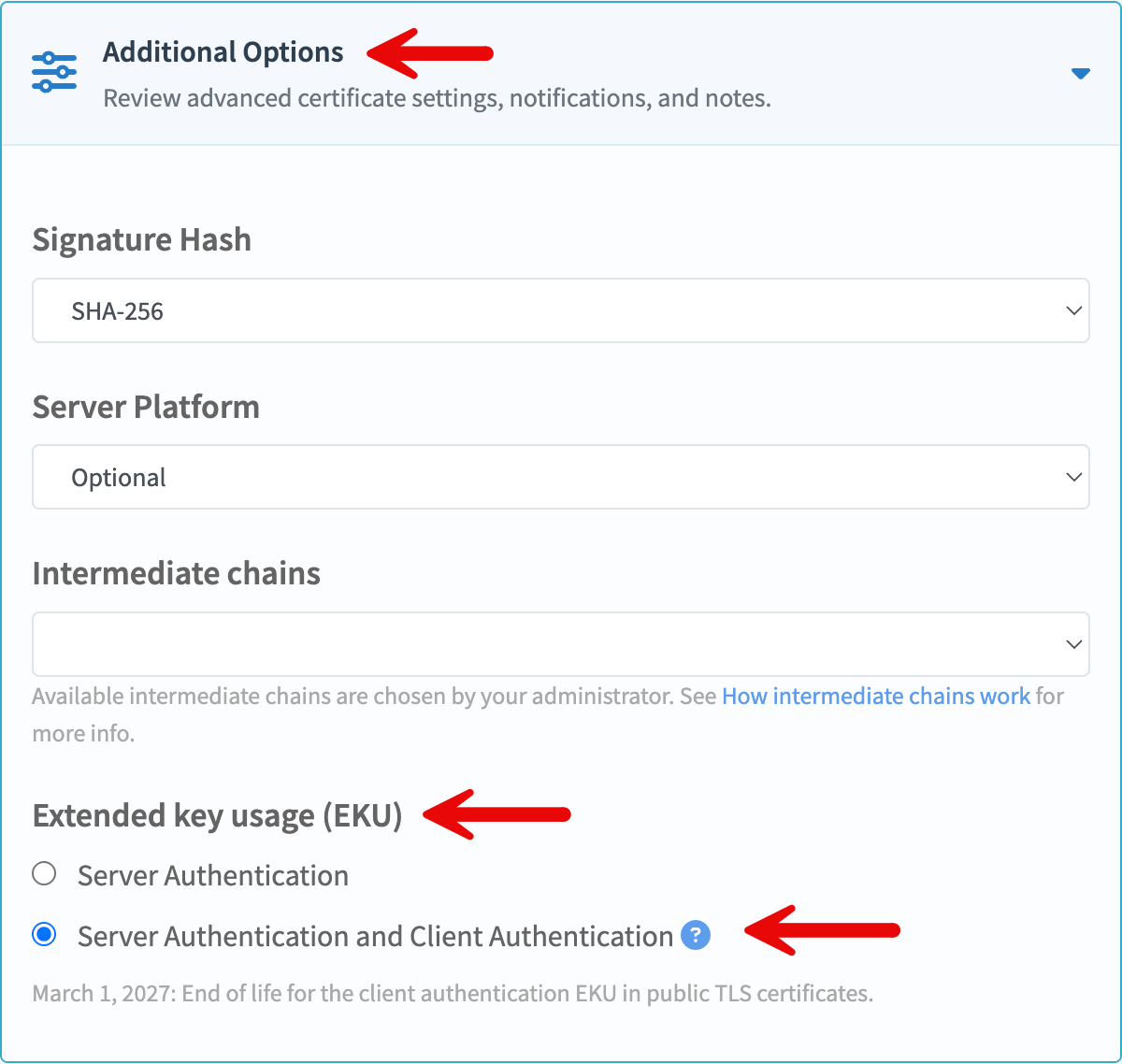
- That dual-EKU override option goes away on ~March 1, 2027. After that date, DigiCert will issue public TLS certificates with the Server Authentication EKU only—no Client Authentication EKU opt-in.
- Existing certificates issued with the Client Authentication EKU before that date remain trusted until they expire. Reissues, duplicates, and renewals after the cutoff will not include Client Authentication EKU.
Sectigo / PositiveSSL
Sectigo and PositiveSSL have already removed the dual EKU (Client Authentication + Server Authentication) from newly issued public TLS certificates. New Sectigo/PositiveSSL TLS certificates are issued with the Server Authentication EKU only.
What you need to do
- Securing a website only: You don’t need to do anything.
- DigiCert/GeoTrust for mTLS or client authentication: Plan a transition before ~March 1, 2027, when the dual-EKU override disappears. A primary alternative is DigiCert X9 PKI for TLS (see DigiCert X9 PKI for TLS below). Private PKI remains an option for internal-only needs.
- Sectigo/PositiveSSL for client authentication: Dual-EKU public TLS certificates are no longer issued. Switch to a DigiCert/GeoTrust TLS product while the dual-EKU opt-in is still available (see above), or move to DigiCert X9 PKI for TLS for ongoing mTLS and client-auth needs (see DigiCert X9 PKI for TLS).
Why this change
This aligns with Google Chrome’s root program requirements to improve security and interoperability across public CAs.
For DigiCert details, options, and product links, see:
CertCentral Change Log – March 1, 2027.
October 15, 2026
Public TLS certificates move to DigiCert G5 roots
Starting October 15, 2026, newly issued DigiCert and GeoTrust browser-trusted TLS certificates (DV, OV, and EV)—including new orders, reissues, renewals, duplicates, and ACME issuance—will chain by default to one of these dedicated TLS roots:
- DigiCert TLS RSA4096 Root G5
- DigiCert TLS ECC P384 Root G5
Certificates issued before October 15, 2026 are unchanged. They remain trusted until they expire.
Sectigo / PositiveSSL
This DigiCert root change does not apply to Sectigo or PositiveSSL certificates.
What you need to do
- Typical HTTPS websites: No action is required if you always install the full certificate chain DigiCert provides (end-entity certificate, intermediate CA, and the G5 cross-signed root when it is included). Do not install only the leaf certificate.
- Certificate pinning or hard-coded roots/ICAs: Remove pinning of public TLS roots or intermediates before October 15. Pinning is no longer a recommended practice, and chain updates will become more frequent. Review any automation, appliances, or custom trust stores that expect today’s G2/G3 hierarchy.
- Non-browser devices, mTLS, or APIs: Public WebPKI is a poor fit when browsers are not in the trust path. For multi-organization mTLS, see DigiCert X9 PKI for TLS. For internal-only needs, use private PKI. Contact GeoCerts support if you need a non-browser public hierarchy.
The G5 TLS roots are cross-signed by DigiCert Global Root G2 so older clients that do not yet have G5 in their trust store can still build a chain—if you install the complete bundle.
Why this change
Google Chrome is limiting each CA to two active TLS roots in the Chrome Root Store (effective September 15, 2027). DigiCert is consolidating browser-trusted TLS issuance onto the two G5 TLS roots now so you can find compatibility issues before G2/G3 TLS hierarchies leave Chrome and other browsers.
Coming next year — annual ICA rotation (October 15, 2027)
Starting October 15, 2027, DigiCert will begin a phased annual replacement of browser-trusted TLS intermediate CA (ICA) certificates, in preparation for shorter-lived ICAs and roots. New, reissued, and duplicate public TLS certificates will use the new G5 ICAs by default. Same guidance: install the full chain; do not pin intermediates.
For DigiCert’s full root strategy, use cases, and G5 chain guidance, see:
DigiCert’s Root Strategy: Aligning with New Industry Standards.
Recent changes
September 30, 2026
Choose ACME automation while requesting a certificate
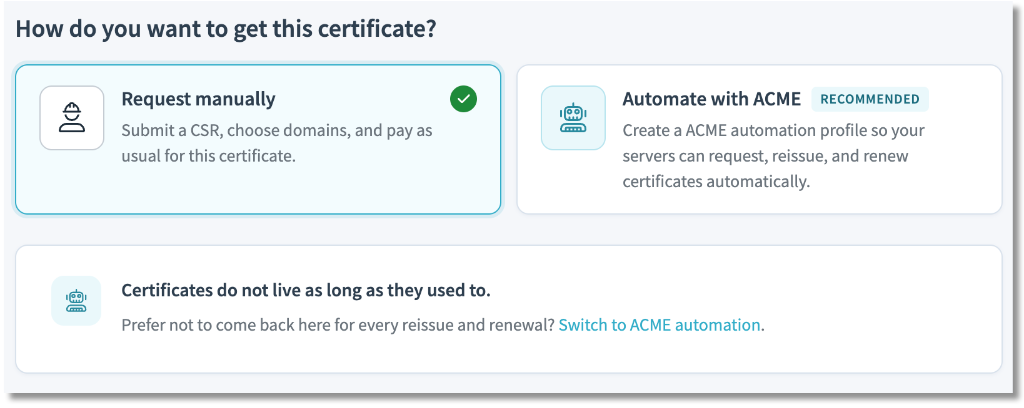
On a new SSL certificate request or a renewal in CertCommand, How do you want to get this certificate? offers Request manually and Automate with ACME (marked Recommended).
Choose carefully. A certificate requested manually cannot later be converted into an ACME-automated certificate. If you want automation, choose Automate with ACME before completing the request.
You see this when you are signed in and the account already has an ACME-capable product enabled. It does not appear on a reissue, on a non-SSL or private PKI product, or when the order being renewed already has an ACME profile. An IP address as the common name or a SAN shows the ACME choice as unavailable, without Recommended.
Request manually stays selected, and you finish the CSR form exactly as before. Automate with ACME and Switch to ACME automation open the existing Create an ACME Directory URL form on this page. You still submit Create and show credentials.
What changed
Previously, a new SSL request or a renewal opened the manual CSR form. That form is unchanged. Qualifying requests now also offer this ACME choice on the same page.
Documentation
September 28, 2026
Use the Common Name and SANs from your CSR
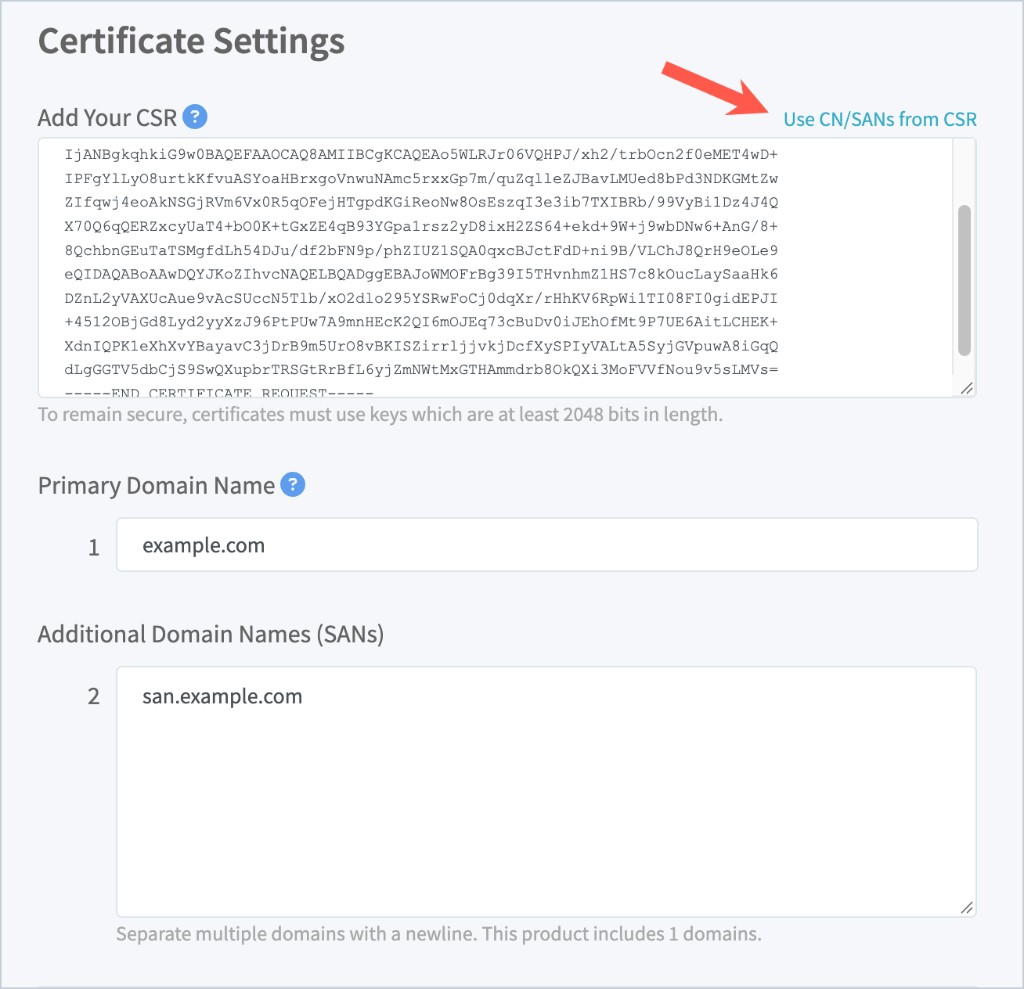
On every SSL/TLS certificate request in CertCommand, Use CN/SANs from CSR replaces the Primary Domain Name and Additional Domain Names (SANs) currently on the form with the Common Name and subject alternative names in your certificate signing request (CSR).
This applies to all SSL/TLS requests for every DigiCert brand and every Sectigo brand, including DigiCert, GeoTrust, Sectigo, and PositiveSSL.
On Certificate Settings, paste the CSR under Add Your CSR, then select Use CN/SANs from CSR (to the right of Add Your CSR). After the fields update, select Undo to restore the previous names.
What changed
Previously, CertCommand filled Primary Domain Name and Additional Domain Names (SANs) from the CSR only when those fields were empty. If the fields already contained values, you had to update them manually to match the CSR.
Use CN/SANs from CSR now replaces those existing values with the Common Name and SANs from the CSR. Undo restores the previous values.
September 15, 2026
CRL partitioning for public TLS certificates
On September 15, 2026, public DigiCert TLS certificates began using Certificate Revocation List Distribution Point (CRLDP) URLs that point to smaller, partitioned CRLs. Each partitioned CRL holds a subset of revocations for the issuing intermediate CA (about 9.5 MB each). Together, the partitions still cover all revoked certificates.
What you need to do
No action is required for typical HTTPS use. Browsers, operating systems, and other software usually handle revocation checking automatically.
For full details, see:
CertCentral Change Log – September 15, 2026.
August 30, 2026
Persistent DNS TXT for DigiCert and GeoTrust DCV
GeoCerts CertCommand now supports Persistent DNS TXT as a domain control validation (DCV) method for DigiCert and GeoTrust SSL/TLS certificates.
What’s new
- Publish one DNS TXT record at
_validation-persist.example.com(or_validation-persist.sub.example.comfor an exact FQDN). - The TXT value is a persistent URI shown in CertCommand. It does not rotate like a DNS TXT Token.
- Leave the record published. When you select Persistent DNS TXT again on a later request or reissue, DigiCert can re-check the same hostname and URI instead of asking for a new token.
- This method is not available for Sectigo or PositiveSSL, IP-address names, or ACME orders.
Why this helps
Public TLS lifetimes are shorter, so domains are validated more often. Persistent DNS TXT does not skip DCV. It keeps you from replacing a random TXT token on every cycle, and it uses a dedicated _validation-persist label so apex TXT records (SPF and similar) stay untouched.
Documentation
- Persistent DNS TXT — how to select the method, copy TXT host and value, and leave the record in place
- Domain Control Validation (DCV) — all CertCommand DCV methods
- DNS TXT token — the one-time token method this replaces when you can keep a long-lived record
July 11, 2026
Sandbox ACME Directory URLs
GeoCerts’ CertCommand management portal now supports Sandbox ACME Directory URLs for testing ACME automation without production charges or orders.
What’s new
- When creating an ACME Directory URL, select Create sandbox ACME URL to connect to the GeoCerts ACME sandbox environment.
- Sandbox URLs use the same EAB credential model as production URLs but issue short-lived test certificates (3-day validity, DV Flex products only).
Why this helps
New ACME users can validate EAB authentication, domain control validation (especially DNS credentials), and deployment on a web server—or their own deploy process for load balancers—before moving to a production ACME Directory URL.
Documentation
July 1, 2026
DigiCert ACME Client for CertCommand automation
GeoCerts recommends the DigiCert ACME Client (DAC) for ACME automation with CertCommand ACME Directory URLs. Use it to request, install, and renew DigiCert and GeoTrust certificates against the Directory URLs you create in CertCommand.
Why we recommend it
- Built for DigiCert’s ACME backend and External Account Binding (EAB)
- One CLI (
dc-acme) for Linux and Windows - Runs as a managed service so renewals don’t depend on ad-hoc cron or Task Scheduler jobs when automation is enabled
Get started
- Install the DigiCert ACME Client — install steps, verification, and next steps
- Linux:
curl "https://automation-service.digicert.com/dc-acme/linux/install.sh" | sudo bash - Windows (PowerShell as Administrator):
iex ((New-Object System.Net.WebClient).DownloadString('https://automation-service.digicert.com/dc-acme/windows/install.ps1')); Install-DigicertAcmeClient
Already using Certbot or Win-ACME? See Alternative ACME Clients.
June 15, 2026
DigiCert X9 PKI for TLS now available
GeoCerts now offers DigiCert X9 PKI for TLS—a DigiCert certificate product for host-to-host TLS use cases (such as mutual TLS / mTLS and API authentication) that need both Server Authentication and Client Authentication EKUs.
Unlike browser-trusted public TLS certificates, X9 PKI for TLS is governed by ASC X9 certificate policy and uses a common root of trust outside browser root programs. It is the DigiCert-recommended path when public TLS dual-EKU options go away (~March 1, 2027). See Removing the Client Authentication EKU.
Who it’s for
- Organizations that use TLS certificates for mTLS, server-to-server authentication, or other non-browser client authentication
- Multi-organization environments that need a shared, interoperable trust root (not only internal private PKI)
How to order
Learn more and order on GeoCerts: DigiCert X9 PKI for TLS. Questions about profiles, validation, or deployment? Contact GeoCerts support — we’re happy to help.
June 1, 2026
All public TLS certificates must be logged to CT logs
Starting June 1, 2026, DigiCert logs all public TLS certificates—including canaries and test certificates—to at least one Certificate Transparency (CT) log. This applies across DigiCert public TLS products and brands (including DigiCert, GeoTrust, Thawte, and RapidSSL).
This change mainly closes DigiCert’s former CT-logging opt-out for accounts that had turned logging off. It aligns with Google Chrome Root Program Policy, which requires CAs to log all public TLS certificates by mid-June 2026.
What you need to do
- Most GeoCerts customers: No action is required. GeoCerts does not expose a CT-logging opt-out in the usual order path, and DigiCert logs public TLS certificates by default.
- Certificates that must stay out of public CT logs need a private PKI path—not public trust.
For DigiCert’s full details, see:
CertCentral Change Log – June 1, 2026.
MPIC corroboration expanded (three, then four remote locations)
Multi-Perspective Issuance Corroboration (MPIC) helps stop attackers from tricking a certificate authority into issuing a certificate for a domain they don’t control—for example by manipulating internet routing (such as BGP hijacking). Under CA/Browser Forum rules, public CAs must now check domain control validation (DCV) and CAA results from multiple independent network locations, not just one vantage point. If those perspectives don’t agree, issuance stops.
DigiCert’s explanation: Multi-Perspective Issuance Corroboration for Digital Certificates.
DigiCert expanded the number of remote perspectives it uses to match the CA/Browser Forum phase schedule:
- February 24, 2026: Corroboration from at least three remote network locations across at least two Regional Internet Registry regions.
- June 1–14, 2026: Corroboration from at least four remote network locations across at least two regions.
What you need to do
MPIC applies to all common DCV methods DigiCert uses—including HTTP file/ACME HTTP-01 and DNS-based methods (DNS TXT, Persistent DNS TXT, DNS CNAME, ACME DNS-01)—plus CAA checks.
For CertCommand order DCV (not ACME), see Domain Control Validation.
- If you use IP allowlists, geo-blocking, or other network filters on the systems DigiCert must reach for validation (web servers for HTTP DCV, or authoritative DNS for DNS DCV), allow DigiCert’s DCV/MPIC perspectives so checks from multiple locations can succeed.
- If those endpoints are already reachable from the public internet without regional or IP restrictions, you likely need no changes—just expect DigiCert to corroborate the same DCV/CAA result from more remote locations than before.
For full details, see:
CertCentral Change Log – June 1, 2026 and
February 24, 2026.
May 15, 2026
G2/G3 ICA and cross-signed root revocations
On May 15, 2026, DigiCert revoked specific G2/G3 intermediate CA (ICA) certificates and certain G5 cross-signed roots as part of moving multipurpose G2/G3 roots to dedicated TLS hierarchies.
What’s important
- End-entity certificates issued from revoked ICAs were not revoked, but they must be replaced—if the ICA in the trust chain is revoked, those end-entity certificates are no longer trusted.
- Certificates that relied on an alternative trust path through a revoked cross-signed root can fail chain building after the revocation date.
What you need to do
Replace affected certificates so they chain to the current DigiCert intermediates/roots. Prefer DigiCert’s official lists of revoked ICAs and cross-signed roots when identifying impact.
For full details and replacement guidance, see:
CertCentral Change Log – May 15, 2026.
March 10, 2026
New dedicated IPv4 and IPv6 addresses
On March 10, 2026, DigiCert added dedicated IPv4 addresses and assigned new dedicated IPv6 addresses for specific services (including CertCentral-related platforms).
What you need to do
- If you do not use IP allowlists: No action is required.
- If you do: Update allowlists for DigiCert’s published certificate-status / service IP addresses so outbound traffic continues to work.
For the address lists and affected platforms, see DigiCert’s knowledge base and:
CertCentral Change Log – March 10, 2026.
March 3, 2026
DNSSEC validation for domain control and CAA checks
On March 3, 2026, DigiCert began validating DNSSEC when it is present during domain control validation and DNS CAA checks. This affects products that require domain validation and CAA checks before issuance (such as public TLS).
What you need to do
DNSSEC is not required. If you do not use DNSSEC, nothing changes. If you do, ensure DNSSEC is correctly configured—misconfigured DNSSEC can cause DCV or CAA failures.
For full details, see:
CertCentral Change Log – March 3, 2026.
February 24, 2026
199-day maximum validity for public TLS certificates
On February 24, 2026, DigiCert stopped accepting public TLS certificate requests with validity greater than 199 days (DigiCert’s implementation of the CA/Browser Forum’s 200-day cap). Certificates issued on or after that date cannot exceed that maximum.
This is the first step in CA/Browser Forum Ballot SC081’s industry schedule toward shorter public TLS lifetimes. Sectigo/PositiveSSL follow the Forum’s later phase dates.
| Maximum certificate validity | DigiCert expected date* | Sectigo expected date |
|---|---|---|
| 200 days | February 24, 2026 | March 15, 2026 |
| 100 days | Before March 15, 2027 | March 15, 2027 |
| 47 days | Before March 15, 2029 | March 15, 2029 |
*DigiCert ordinarily implements CA/Browser Forum hard dates at least two weeks early. Exact dates can still change.
These dates can change as CA/Browser Forum requirements and CA implementation plans are updated.
For DigiCert details, see:
CertCentral Change Log – Moving to 199-day validity.
Domain validation reuse shortened to 199 days
Domain validation reuse applies to OV and EV certificates: after DigiCert validates that you control a domain, that validation can be reused for later OV/EV orders for the same domain—without repeating DCV—until the reuse period expires. Then you must revalidate before DigiCert will issue another OV/EV certificate for that domain.
This does not apply to DV certificates. DV has no domain validation reuse. DigiCert must revalidate every domain on a DV order each time a certificate is issued or reissued.
On February 24, 2026, DigiCert shortened the OV/EV domain validation reuse period to 199 days, including for existing domain validations (previously up to 397 days). That is DigiCert’s implementation of the CA/Browser Forum’s 200-day domain validation reuse cap.
| Maximum domain validation reuse period | DigiCert expected date* | Sectigo expected date |
|---|---|---|
| 200 days | February 24, 2026 | March 15, 2026 |
| 100 days | Before March 15, 2027 | March 15, 2027 |
| 10 days | Before March 15, 2029 | March 15, 2029 |
*DigiCert ordinarily implements CA/Browser Forum hard dates at least two weeks early. Exact dates can still change.
These dates can change as CA/Browser Forum requirements and CA implementation plans are updated.
What you need to do
If you order OV or EV certificates, expect more frequent domain revalidation. Watch domain validation expiration dates and revalidate before they expire so renewals and new OV/EV orders are not delayed. DV customers see no change to reuse rules—DCV remains required on every issue and reissue. How-tos: Domain Control Validation.
For full details, see:
CertCentral Change Log – Shortening the domain validation reuse period to 199 days.
OV organization validation reuse shortened to 397 days
Organization validation reuse applies to OV certificates: after DigiCert validates your organization, that organization validation can be reused for later OV orders—without repeating organization validation—until the reuse period expires. Then DigiCert must revalidate the organization before issuing another OV certificate for it.
This does not apply to DV certificates. DV has no organization validation (and no organization validation reuse).
On February 24, 2026, DigiCert shortened the OV organization validation reuse period from 825 days to 397 days, including for existing OV organization validations. That is DigiCert’s implementation of the CA/Browser Forum’s 398-day OV organization validation reuse cap.
| Maximum OV organization validation reuse period | DigiCert expected date* | Sectigo expected date |
|---|---|---|
| 398 days | February 24, 2026 | March 15, 2026 |
*DigiCert ordinarily implements CA/Browser Forum hard dates at least two weeks early. Exact dates can still change.
These dates can change as CA/Browser Forum requirements and CA implementation plans are updated.
What you need to do
If you order OV certificates, plan organization revalidation on the shorter ~397-day cycle so renewals and new OV orders are not delayed.
For full details, see:
CertCentral Change Log – Shortening the organization validation reuse period for public OV TLS certificates to 397 days.
459-day maximum validity for public code signing certificates
Code signing certificates are used to digitally sign software, scripts, and other executables so users and platforms can verify the publisher and that the code has not been tampered with. This change is about how long a newly issued public code signing certificate may remain valid—not TLS/SSL website certificates.
On February 24, 2026, DigiCert stopped accepting public code signing certificate requests with validity greater than 459 days. Certificates issued on or after that date cannot exceed that maximum. That is DigiCert’s implementation of CA/Browser Forum Ballot CSC-31’s 460-day cap (down from 39 months).
| Maximum code signing certificate validity | DigiCert expected date* | Sectigo expected date |
|---|---|---|
| 460 days | February 24, 2026 | February 23, 2026 |
*DigiCert ordinarily implements CA/Browser Forum hard dates early (CSC-31’s industry date is March 1, 2026). Exact dates can still change.
These dates can change as CA/Browser Forum requirements and CA implementation plans are updated.
What you need to do
DigiCert sells public code signing certificates for one year at a time. Renew when the certificate expires.
Documentation
- Code Signing — Overview, validity, and how to order and reissue
- Order a code signing certificate — CertCommand order and reissue
For DigiCert details, see:
CertCentral Change Log – Moving to 459-day validity for public code signing certificates.
2025
DigiCert KeyLocker for code signing
GeoCerts began offering DigiCert KeyLocker as a code signing private-key provisioning option. KeyLocker is DigiCert’s cloud HSM service: it generates and stores code signing private keys in FIPS 140-2 Level 3–compliant cloud hardware so you do not need a shipped USB token or your own on-premises HSM.
Sign from anywhere, avoid lost/stolen tokens, and integrate signing into CI/CD workflows. When ordering DigiCert code signing through GeoCerts, choose KeyLocker as the provisioning method where available.
Learn more
- DigiCert KeyLocker with GeoCerts
- DigiCert KeyLocker
- Contact GeoCerts support for ordering help
Common Mark Certificates (CMC)
GeoCerts began offering DigiCert Common Mark Certificates (CMC) alongside Verified Mark Certificates (VMC). Mark certificates support BIMI so your brand logo can appear next to authenticated email in supported inboxes.
CMC is for organizations that need BIMI logo display without a registered trademark—proof of prior public use of the logo is required instead. VMC remains the path for registered trademarks (and can enable additional inbox trust indicators such as Gmail’s blue checkmark). DMARC enforcement (p=quarantine or p=reject) is required for both.
Learn more
ACME Directory URLs in CertCommand
GeoCerts launched ACME Directory URLs in CertCommand so customers can automate DigiCert and GeoTrust TLS certificate issuance and renewal with ACME clients.
Create a Directory URL profile (product, brand, validity settings), then use the generated ACME Directory URL and External Account Binding (EAB) credentials with the DigiCert ACME Client or another ACME client.
Documentation